

30th General Assembly of IOTA “Empowering Tax Administrations to Tackle Tax Compliance Challenges through the Use of Artificial Intelligence and Behavioural Insights”
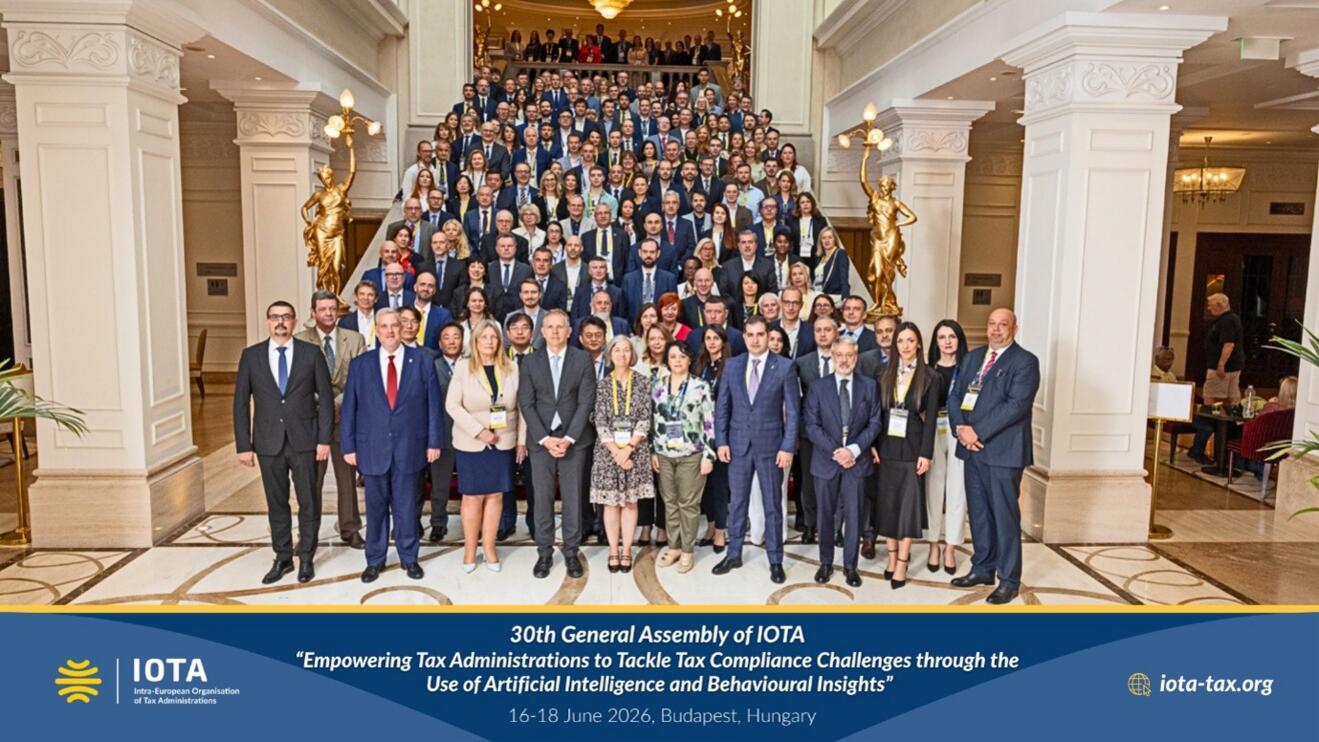
The 30th General Assembly of IOTA “Empowering Tax Administrations to Tackle Tax Compliance Challenges through the Use of Artificial Intelligence and Behavioural Insights”, held under the flag of the Hungarian Presidency represented by the National Tax and Customs Administration of Hungary, took place between 16 and 18 June 2026 in Budapest, Hungary.
It was a pleasure to welcome a diverse audience, including senior officials from IOTA's Member and Associate Member Countries' tax administrations, high-ranking officials from the Hungarian government, and guests from around the world. Among them were leading tax experts and representatives from international organisations such as the Asian Development Bank (ADB), Intra-American Network of Tax Administrators (CIAT), International Bureau of Fiscal Documentation (IBFD), International Fiscal Association (IFA), International Monetary Fund (IMF), Organisation for Economic Co-operation and Development (OECD), and the World Bank, alongside IOTA observers, business community representatives, tax practitioners, and members of academia.
The event attracted more than 215 in-person participants and numerous delegates who joined virtually. Throughout the three days of the Jubilee Assembly, the programme featured dynamic plenary and parallel sessions, interactive discussions, an exhibition showcasing innovative technologies, and a variety of learning and networking opportunities.
The Administrative Session of the 30th General Assembly took place on 16 June and was followed by the Technical Session on 17 and 18 June 2026. The professional theme, “Empowering Tax Administrations to Tackle Tax Compliance Challenges through the Use of Artificial Intelligence and Behavioural Insights”, explored how tax administrations can leverage technological innovation and behavioural science to improve compliance, modernise operations, and enhance taxpayer services.
As part of the Technical Session, delegates were invited to explore the IOTA Expo, “Artificial Intelligence and Behavioural Insights in Tax Compliance”, showcasing innovative solutions, emerging technologies, and practical approaches that are helping tax administrations address compliance challenges in an increasingly digital environment.
Administrative Session – 16 June 2026
During the Administrative Session, the Hungarian Presidency presented an overview of the key achievements and important decisions taken by the Presidency and the Executive Council during the 2025/2026 term. IOTA members also approved the Internal Auditors' Report, the statutory documents, the IOTA Budget 2027 and the IOTA Work Programme 2027, and the implementation plan 2025 of the IOTA Strategy 2023–2027.
The General Assembly approved the admission request of the Tax Committee of the Republic of Uzbekistan, which became IOTA's second Associate Member, following the Republic of Korea, further strengthening cooperation with tax administrations beyond Europe.
The Assembly also elected the new Executive Council for the 2026/2027 term. The following member countries were appointed: Armenia, Azerbaijan, Belgium, Croatia, Estonia, Finland, Romania and Switzerland.
A significant moment of the Administrative Session was the IOTA Flag Handover Ceremony, during which the Presidency of the Organisation was formally transferred from Hungary to the Republic of North Macedonia. Elena Petrova, Director General of the Public Revenue Office of North Macedonia, became the new President of IOTA for the 2026/2027 term. The handover of the IOTA flag symbolises continuity, cooperation, and the shared commitment of IOTA members to strengthening tax administrations across the community.
The first day concluded with a Director General Panel Discussion, providing a strategic platform for senior leaders to exchange views on emerging challenges and opportunities shaping the future of tax administration and international cooperation.
Technical Session – 17–18 June 2026
The Technical Session commenced with an Opening Ceremony featuring keynote addresses from Mr Attila Kövesdi, State Secretary for Tax Policy at the Hungarian Ministry of Finance, Ms Csilla Tamás Czinege, Acting Director General of the National Tax and Customs Administration of Hungary and Outgoing President of IOTA and Ms Alix Perrignon de Troyes, Executive Secretary of IOTA. They set the scene for discussions on the transformative role of artificial intelligence and behavioural insights in modern tax administration.
The first day focused on the rise of artificial intelligence in tax administration and featured keynote contributions from Helgar Thomic-Sutterlüti of the Federal Ministry of Finance of Austria, Joshua Aslett from the International Monetary Fund, Paul Marsh from the OECD Forum on Tax Administration, and Thomas Monefeldt from Netcompany.
Subsequent sessions explored practical applications of AI-driven tax compliance and governance frameworks. Participants heard valuable presentations from Ferenc Vágujhelyi, former President of IOTA; Antonino Virgillito from the Italian Revenue Agency; James Mansueto from the Malta Tax and Customs Administration; Fabio Menis from SAS Institute; and Isaiah Leckie from Fast Enterprises.
Discussions on governance, ethics, and risks in automated decision-making brought together experts, including Bjørn Eriksen from the Norwegian Tax Administration, Gabriel Bellinger from Accenture, Anna Valchanova from AVASK, Thomas Monefeldt from Netcompany, and Alexandre Negadi from SAS Institute. The programme also examined behavioural insights for good governance through contributions from Farid Isayev of the State Tax Service of Azerbaijan, Peter Toth of the National Tax and Customs Administration of Hungary, and Synve Røine Fossum of the Norwegian Tax Administration.
The second day introduced an innovative parallel-session format, allowing delegates to explore practical examples at the intersection of behavioural science and artificial intelligence across three thematic streams: Enhanced Tax Compliance through AI-Supported Processes, Predictive Risk and Behavioural Profiling, and Proactive Compliance and Service Delivery.
Participants benefited from presentations by experts representing Greece, Azerbaijan, AVASK, DataTorque, SAS Institute, Moody's Analytics, RoyaltyRange, and S&P Global Market Intelligence, followed by interactive open-space discussions that enabled participants to move freely between groups and exchange experiences and perspectives.
The programme concluded with high-level panel discussions on how behavioural insights and artificial intelligence can jointly contribute to smarter compliance and how these transformative forces may shape tax administration by 2030. Contributions from experts representing Armenia, Norway, Capgemini, Mastercard, DataTorque, Netcompany, and other partner organisations highlighted both the opportunities and challenges associated with building resilient, intelligent, and citizen-centred tax administrations.
Throughout the Technical Session, participants were invited to visit the IOTA Expo, which brought together the National Tax and Customs Administration of Hungary, AVASK, Accenture, Capgemini, DataTorque, Fast Enterprises, Moody's Analytics, Netcompany, RoyaltyRange, SAS Institute, and S&P Global Market Intelligence. Through interactive demonstrations and practical case studies, exhibitors showcased cutting-edge technologies and behavioural solutions that are already transforming tax administration practices.
As part of the Expo, delegates were also invited to visit the dedicated IOTA30 Anniversary Booth, an interactive space celebrating three decades of cooperation within the IOTA community. The booth featured anniversary activities, including a quiz game that let participants test their knowledge of IOTA's history and milestones in an engaging, enjoyable way.
The 30th General Assembly concluded with the adoption of the Assembly Communiqué and closing remarks from the outgoing President of IOTA. The event reaffirmed IOTA's commitment to fostering international cooperation, promoting innovation, and supporting tax administrations in addressing the increasingly complex challenges of tax compliance in the digital age.