IOTA Digital Workshop Explores Approaches To Combating International Tax Avoidance Through Offshore Structures
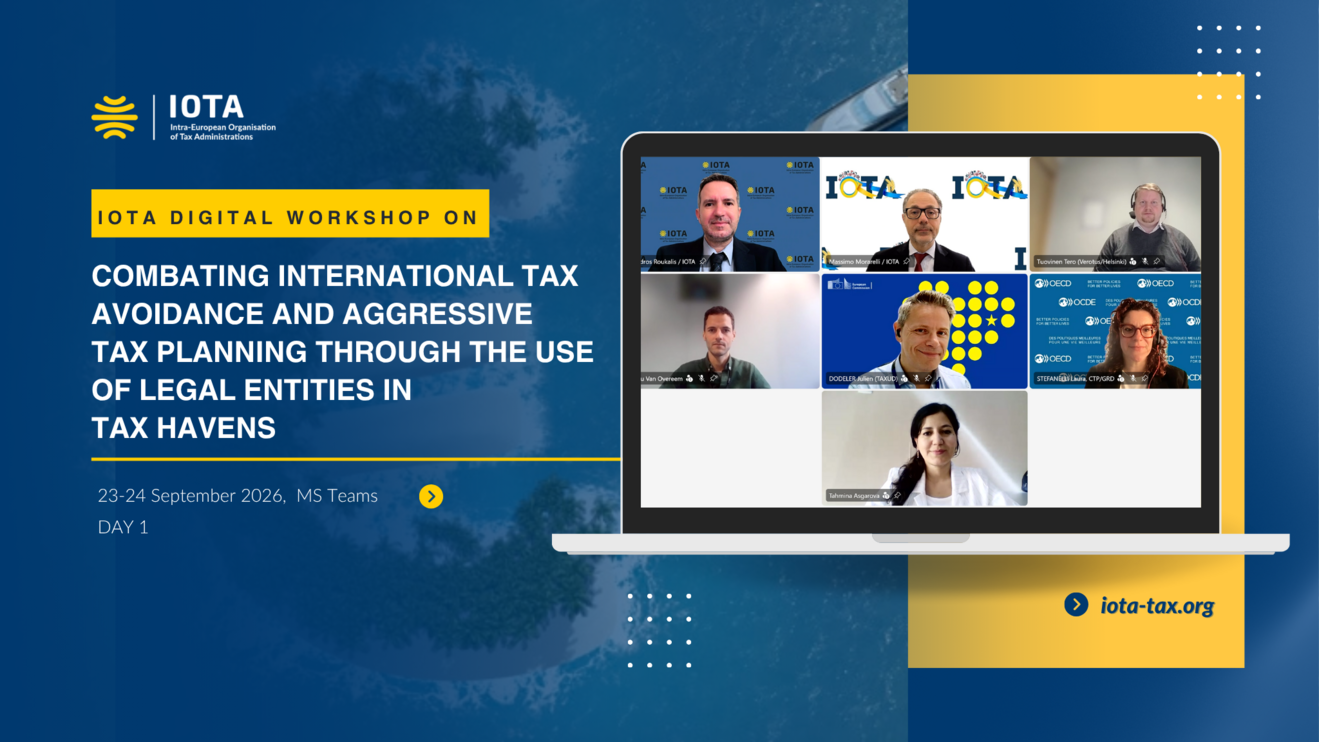
On 23–24 September 2026, IOTA held a Digital Workshop on “Combating international tax avoidance and aggressive tax planning through the use of legal entities in tax havens.” The two-day event brought together nearly 300 IOTA member tax administration officials to exchange experiences and practical approaches to identifying and challenging complex international tax avoidance schemes involving offshore structures.
The Workshop addressed the challenges faced by tax administrations in identifying arrangements involving legal entities in low- or no-tax jurisdictions, including structures that may be used to shift profits, conceal ownership or exploit differences between jurisdictions. Particular attention focused on the “substance over form” principle, identifying concealed beneficial ownership, transfer pricing considerations, and enhanced international cooperation.
Exploring the legislative framework and beneficial ownership
The first day opened with an overview of the legislative background relevant to cross-border arrangements and aggressive tax planning. Laura Stefanelli from the Organisation for Economic Co-operation and Development presented recent developments in the OECD BEPS framework, while Julien Dodeler from the European Commission – DG TAXUD provided insights into the EU framework, including the current status of information exchange through DAC 6.
The programme then turned to the experiences of jurisdictions with preferential tax regimes and commonly used structures. Mathieu van Overeem from Belgium presented on the domestic tax regime for offshore structures in light of international law, followed by Tero Tuovinen from Finland, who shared the Finnish Tax Administration’s experience, in identifying tax haven companies used for tax avoidance and related control measures. Tahmina Asgarova from Azerbaijan addressed indicators that may signal a lack of real economic substance in an offshore company.
The first day concluded with a group discussion on methods for identifying hidden beneficial ownership in aggressive tax avoidance structures, allowing participants to exchange their administrations’ experiences and approaches.
Assessing economic substance and real business activity
The second day of the Workshop continued with a focus on substance over form and on identifying indicators of whether an offshore company conducts genuine business activities rather than existing primarily on paper.
Hannah Hashemi from the United Kingdom delivered a country presentation on substantial activities in no- or nominal-tax jurisdictions; Matts Hennum Johanson from Norway presented on confronting treaty shopping through shell companies; and Armen Gyurjyan from Armenia presented a case-based approach to identifying hidden beneficial ownership and lack of economic substance.
The Workshop also addressed recent developments in Global Minimum Tax (GMT) rules. The OECD’s Jeff Mitchell presented updates including the Side-by-Side package, safe harbours and the Implementation Toolkit, as well as their impact on tax competition between jurisdictions.
An interactive group discussion on assessing real business activity provided participants with an opportunity to discuss indicators of legitimate commercial purpose and whether corporate structures and intercompany transactions reflect economic reality. The digital event concluded with a plenary exchange of the outcomes from the group discussions and a wrap-up session.
Sharing practical experiences and strengthening cooperation
The Workshop combined expert presentations, Q&A sessions and facilitated group discussions, creating opportunities for participants to explore practical approaches and share experiences from their respective tax administrations. The Workshop also gave IOTA members an opportunity to deepen their understanding of emerging tax avoidance risks and exchange practical knowledge on identifying artificial arrangements, concealed beneficial ownership, and insufficient economic substance. These exchanges contribute to strengthening tax administrations’ capacity to address complex international tax planning structures.
All materials, presentations, and video recordings, will be made available soon on the event's webpage. The event was facilitated by IOTA International Taxation Experts Alexandros Roukalis and Massimo Morarelli.