IOTA Forum on Tax Debt Management “Innovations and Emerging Technologies for Effective Tax Debt Management”
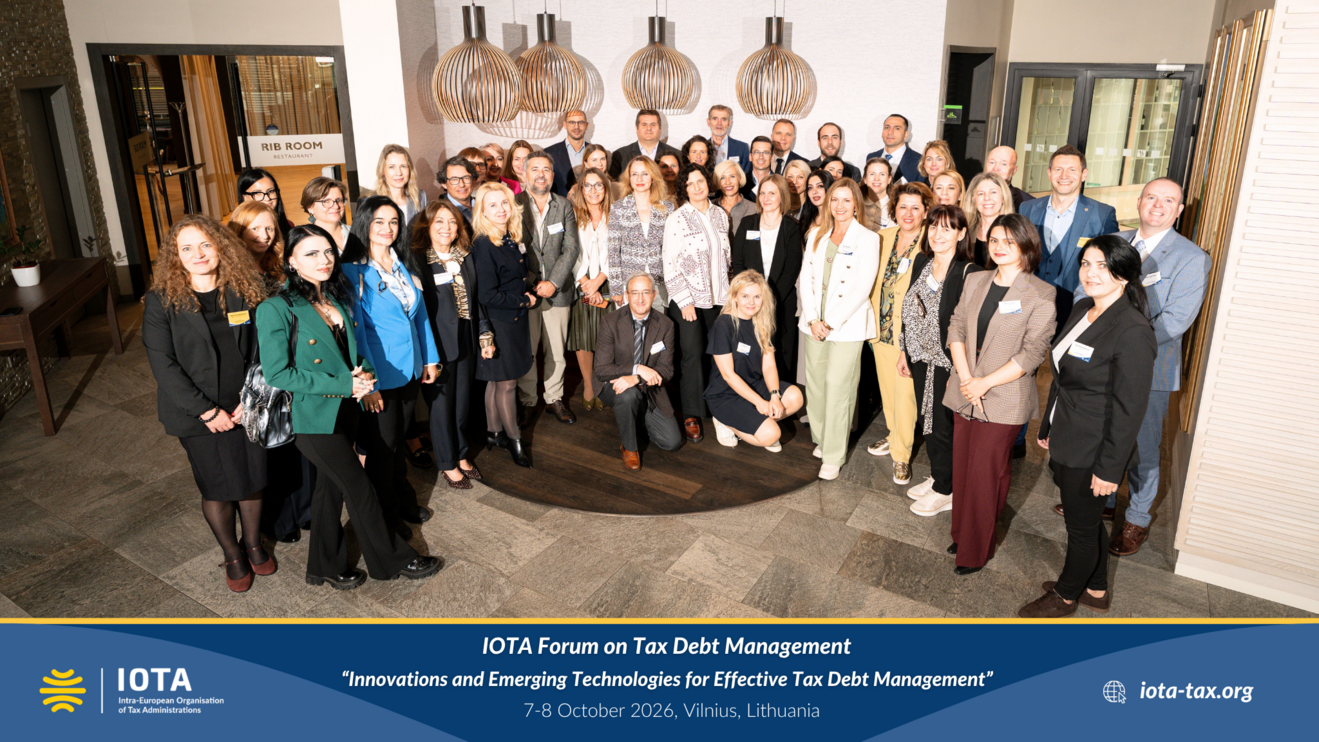
On 7–8 October 2026, IOTA had the pleasure of organising the Forum on Tax Debt Management in Vilnius, Lithuania, in close collaboration with the State Tax Inspectorate under the Ministry of Finance of the Republic of Lithuania (VMI). The hybrid event brought together 44 IOTA member tax administration experts in Vilnius and welcomed more than 25 registered online participants from four Organisation for Economic Co-operation and Development (OECD) jurisdictions, broadening the exchange of international experience and perspectives. Dr Martynas Endrijaitis, Head of the State Tax Inspectorate, opened the event.
Held under the theme “Innovations and Emerging Technologies for Effective Tax Debt Management”, the Forum provided a platform for IOTA member tax administrations to share practical experiences, discuss emerging approaches and explore how technology and organisational innovation can improve debt recovery and taxpayer compliance.
Innovative Approaches to Tax Debt Management
The first day focused on innovative operational models, organisational approaches and legislation, with presentations demonstrating how tax administrations are transforming debt administration and recovery processes.
Experts from IOTA member administrations, including Vitalija Burdeinaja from Lithuania, Antti Heikonen from Finland, Lika Chopuryan from Georgia and Alla Tonoyan from Armenia, shared approaches to organisational transformation, nationwide tax collection practices, performance improvement and innovation in tax debt management.
The discussions continued with a focus on advanced analytics and behavioural approaches. Hilde Lillienskiold from Norway presented data-driven approaches to fair earnings assessment, while Vitalija Burdeinaja took the floor again and explored the use of predictive analytics for smarter tax debt recovery.
Participants also took part in a practical exercise applying new technologies and methods to tax debt collection scenarios. The exercise encouraged the exchange of ideas and approaches, followed by discussions on key challenges, success factors and lessons learned in adopting modern technologies.
The day concluded with Kerli Onno from Estonia sharing insights into automated tax debt collection and Aidan Hastings and Elaine Byrnes from Ireland presenting approaches to transforming compliance through effective enforcement systems.
Technology and New Models for Debt Recovery
The second day explored emerging technologies for complex debt recovery, including the use of data analytics in recovery investigations and approaches to seizing crypto-assets. Fernando Alonso from Spain presented advances in recovery investigations using data analytics, while Julien Garillon and Emeline Zemouli from France shared insights into improving crypto-asset seizure.
Further sessions examined practical applications of technology in debt collection. Veerle Mertens from Belgium presented on shared service centres, while Peter Koedood and Gert Jan Jue from the Netherlands discussed digital debt management and the transition to digital payment arrangements for individuals and businesses with tax debts.
The Forum also explored innovations in tax debt management through robotisation and artificial intelligence. Sweden’s Aurora Hemmungs Wirtén presented on robotisation for temporary payment deferrals, while Portugal’s Hugo Bártolo discussed applying artificial intelligence to debtor analysis and segmentation.
A second practical exercise enabled participants to compare automated and manual approaches to tax debt management, considering potential applications such as AI-driven risk scoring, robotic process automation, predictive analytics and behavioural interventions.
International Cooperation and Future Activities
The Forum featured contributions from IOTA’s international partner organisations, offering broader perspectives on developments in tax debt management. Kohei Mita of the OECD Forum on Tax Administration (FTA) Secretariat presented updates on the organisation’s work in this field.
The meeting also provided an opportunity to review activities under the Forum’s 2026–2027 mandate and introduce IOTA’s new initiative, the Community of Practice on Intelligent Automation of Tax Debt Management processes. The initiative aims to provide another platform for knowledge exchange and cooperation on applying intelligent automation in tax debt management.
Throughout the two-day event, participants exchanged practical experiences and explored how technological developments, data-driven approaches and organisational improvements can contribute to more efficient debt recovery and stronger compliance outcomes. All materials, presentations, and the video recordings will be made available soon on the event's webpage. The IOTA International Expert Anders Obrink and IOTA Work Programme Manager Eugenijus Soldatkovas facilitated the Forum.