IOTA Workshop on Use of Modern Analytical Techniques and IT Solutions to Identify Organised Tax Fraud
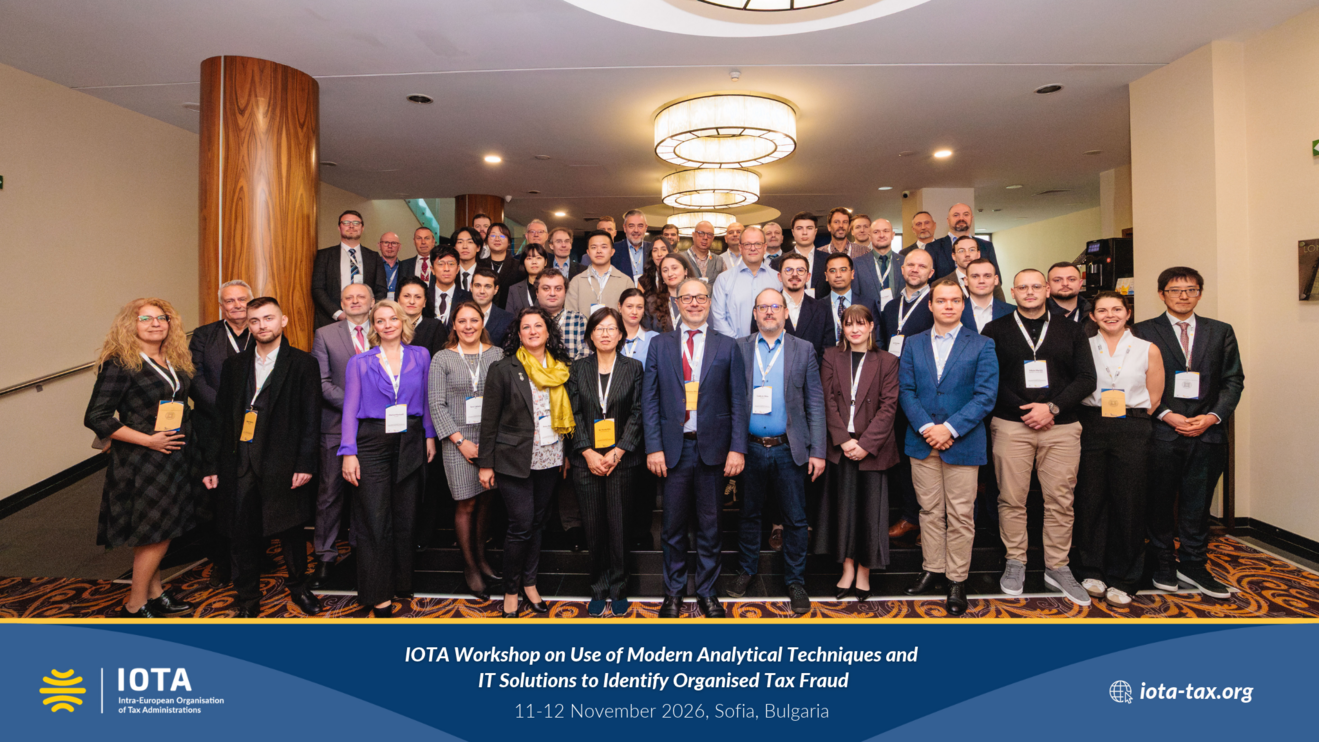
On 11–12 November 2026, IOTA organised a Workshop on “Use of Modern Analytical Techniques and IT Solutions to Identify Organised Tax and VAT Fraud” in Sofia, Bulgaria, in collaboration with the National Revenue Agency of the Republic of Bulgaria. The two-day event opened with remarks from Hristo Markov, Deputy Director General of the National Revenue Agency of the Republic of Bulgaria, and brought together 50 experts from IOTA member tax administrations to exchange experiences and explore how data analytics, innovative technologies, and international cooperation can strengthen the detection and investigation of organised tax and VAT fraud.
As fraud schemes become increasingly complex and interconnected, tax administrations need effective analytical frameworks, reliable data architectures and advanced IT solutions to identify suspicious patterns, assess risks and support timely enforcement action. The Workshop provided a platform for participants to examine current approaches, share practical case studies and discuss how emerging technologies can be translated into operational solutions.
Understanding the Fraud Landscape and Strengthening Analytical Approaches
The first day focused on the evolving landscape of organised tax and VAT fraud, the analytical methods used to detect it and their practical application in tax administrations.
The programme featured contributions from experts representing several jurisdictions and international networks. Bryan Foulger from the United Kingdom presented HMRC's evolving third-party data risk approach, while Marina Marinelić and Serge Hollerich from Eurofisc explored the role of advanced analytics and cross-border cooperation in combating VAT fraud. Martin Iver Jacobsen from Norway shared insights into the Norwegian risk model.
Further presentations examined integrated analysis and international cooperation in detecting cross-border tax evasion, with Seungjoo Lee from the Republic of Korea discussing approaches to tax fraud detection and recovery. Jesper Lundin and Robert Turzo from Sweden explored the misuse of identities as an instrument of organised crime and the implications of eIDAS 2.0.
The practical application of analytical techniques was further illustrated through country case studies. Rafael Padilla from Spain presented the Non-Resident Tax Compliance Project, while Ramóna Györkös from Hungary examined methods for identifying and mapping international cross-invoicing VAT fraud networks.
Interactive group discussions allowed participants to reflect on the analytical practices presented, compare national experiences and identify technical and organisational challenges, as well as approaches that could be adapted to their own administrations.
Advanced Analytics and Artificial Intelligence in Fraud Detection
Building on the foundations established on the first day, the second day turned the focus to advanced analytical techniques, including artificial intelligence and machine learning, as well as ongoing initiatives and planned projects.
The programme featured presentations on a range of innovative approaches. Sara Cattarin from Italy introduced Eurofisc Transaction Network Analysis (TNA) as an advanced IT tool for combating VAT fraud. Akaki Chkhaidze from Georgia explored the use of machine learning to enhance automated VAT refund systems, while Elias Westgaard from Norway presented approaches to identifying fraudulent crypto reporting through artificial intelligence. Aritjon Peri from Albania demonstrated how AI-driven analysis of fiscal receipt data can help detect VAT fraud schemes.
Participants also gained insights into initiatives currently under development. Petya Staneva and Rumen Milanov presented the Bulgarian National Revenue Agency's project to strengthen its tax fraud investigation capacity. In addition, So Young Kim and Massimo Morarelli, International Taxation Experts from the IOTA Secretariat, introduced the IOTA Digital Collaboration Lab on IT Tools and Analytics for Tax Fraud Risk Detection, highlighting opportunities for continued professional exchange and collaboration in this area.
The programme also included private-sector perspectives on advanced analytics and data-driven investigations. Shaun Barry from SAS Institute presented approaches to securing tax fraud detection through data-driven investigations, while Jacob Coles from Redfield explored graph-based retrieval-augmented generation (RAG) for tax investigations.
From Analytical Concepts to Operational Solutions
Throughout the two days, participants engaged in facilitated group discussions examining how analytical concepts and pilot projects can be translated into operational tools and workflows. The discussions addressed common implementation challenges, including data access, IT infrastructure, technical expertise and governance arrangements.
Participants also explored opportunities for bilateral and multilateral cooperation, including the sharing of analytical methods, tools, code and training, as well as closer collaboration between data analysts, IT specialists and auditors.
The Workshop concluded with a plenary exchange of feedback and reflections, providing an opportunity to discuss the outcomes of the group sessions and consider practical next steps for future collaboration.
By combining expert presentations, country experiences, practical case studies and interactive discussions, the Workshop highlighted the growing importance of advanced analytics and modern IT solutions in tackling organised tax and VAT fraud. It also reaffirmed the value of international cooperation and knowledge sharing in helping tax administrations strengthen their analytical capabilities and respond to increasingly sophisticated fraud risks.
IOTA extends its sincere thanks to the National Revenue Agency of the Republic of Bulgaria for its collaboration and hospitality, and to all speakers and participants for their valuable contributions. All materials, presentations, and the video recordings will be made available soon on the event's webpage. The Workshop was facilitated by So Young Kim and Massimo Morarelli of the IOTA Secretariat.